New · Childhood
Myopia Care
MiYOSMART iQ

The Next Step in Myopia Control for Children.
HOYA’s most advanced spectacle lenses for myopia control in children. Built on clinically proven D.I.M.S. Technology, developed further in the Triple Enhanced Design.

Discover
Inside MiYOSMART iQ
How Triple Enhanced Design builds on proven D.I.M.S. Technology to control myopia further.
D.I.M.S. TED Technology
Three Enhancements. One Smart Lens.
MiYOSMART iQ uses D.I.M.S. Technology with Triple Enhanced Design (D.I.M.S. TED), which further improves the optical construction of the lens.
Closer to the centre
The lens design brings the therapeutic zone closer to the centre of the lens, where your child looks most of the day.
Stronger myopia control
The refined optical construction strengthens the myopic defocus that slows the progression of myopia.
A larger treatment area
The therapeutic zone covers a larger area of the spectacle lens, so myopia control is maintained across more of your child’s field of view.
Proven technology
Based on years of clinical research, D.I.M.S. Technology has established MiYOSMART as a leading solution for myopia management. MiYOSMART iQ goes a step further: it uses D.I.M.S. Technology with Triple Enhanced Design, which further improves the optical design of the lens. This innovative solution manages myopia progression in children in a simple, safe, effective and non-invasive way.
Clinical results that push the boundaries of what’s possible
MiYOSMART iQ spectacle lenses were evaluated in a randomised, controlled clinical trial involving children aged 4 to 12 years. Nine out of 10 children experienced no clinically significant progression of myopia within the first 12 months of wearing MiYOSMART iQ lenses. These are the most impressive results achieved to date for D.I.M.S. Technology.
Understand
What Is Myopia?
You may have noticed your child struggling to see clearly at a distance.
Do they have a hard time concentrating at school and at play?
Your child may have myopia, or short-sightedness.
How Does It Happen?
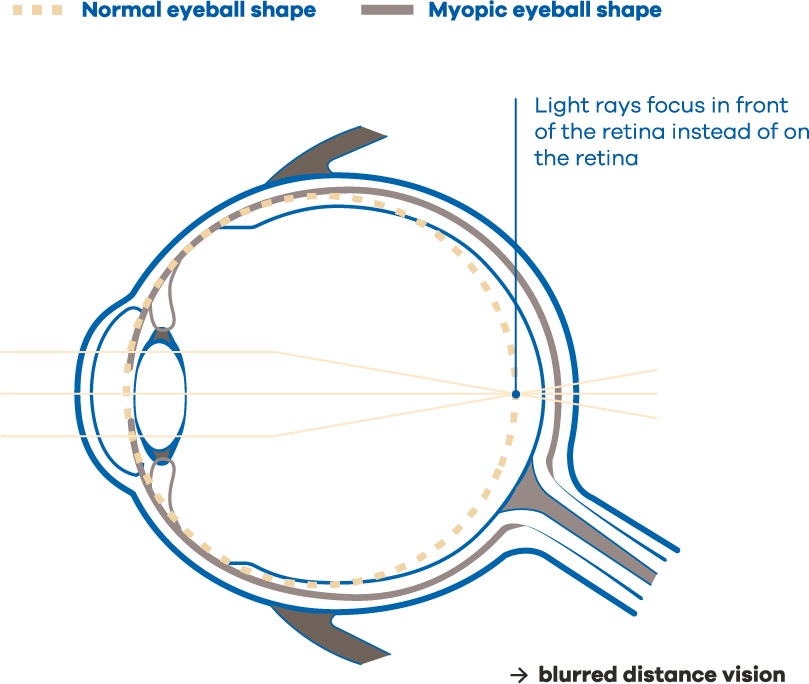
This happens when the eyeball grows fast and becomes too long.
Or when the cornea is too curved and thick.
Instead of focusing on the retina, images focus in front of the retina instead.
If left untreated, myopia can lead to lasting vision problems.
Talk to the HOYA Team
03-6256 0081The bigger picture
Myopia Is a Growing Global Concern
Two findings that shape how eye care professionals now think about childhood short-sightedness.

Half the world by 2050
An estimated 5 billion people, or half of the global population, could be affected by short-sightedness by 2050.

Near work raises the risk
Research shows that more time spent on near-work activities is associated with a greater likelihood of myopia.
Your options
What Can You Do?
While there is no cure, a variety of treatments have shown to be effective in slowing or halting myopia progression. Spectacle lenses are widely recommended as they are safe and easy for your child to wear.
-

Eye Drops
-

Spectacle Lenses
Widely recommended
-

Contact Lenses
The original D.I.M.S. lens
MiYOSMART
The Smart Way to Treat Myopia in Children.
MiYOSMART lenses are innovative spectacle lenses for myopia control. D.I.M.S. Technology has been clinically proven to control myopia, in a lens your child simply wears to school.
60% slow down of myopia progression
MiYOSMART remains available alongside MiYOSMART iQ. Your eye care professional will advise which lens suits your child.
Where it starts
It All Starts With an Eye Exam.
Detect problems early
Regular eye exams help to detect early signs of visual problems.
Family history matters
If either one or both parents are short-sighted, eye exams are even more important.
Early action works
When you identify myopia early, you can slow it down with early, personalised action plans.
Attention!
The test is not a diagnostic tool. It is for informational purposes only and does not replace consultation with a vision care specialist (ophthalmologist or optometrist).
Myopia risk test
Answer 6 questions to assess your child’s myopia risk profile.
It takes about a minute. You will get a risk band, what it means,
and what to do next.
Question 1 of 6
This test is not a medical diagnosis. It is for informational purposes only.
Your result
This test is not a medical diagnosis. It is for informational purposes only.
Common questions
Frequently Asked Questions About Myopia in Children
Myopia is a refractive error rather than an illness your child can catch or recover from. It happens when the eyeball grows slightly too long, so light focuses in front of the retina instead of on it. It is permanent and it tends to progress while a child is still growing, which is why eye care professionals now treat it as something to manage rather than simply correct.
Usually small everyday habits: squinting at the whiteboard or the television, holding books and screens unusually close, sitting closer and closer to the screen, rubbing the eyes, or headaches and tired eyes after reading.
A child has nothing to compare their vision with. Blur that comes on gradually simply becomes normal to them, and they adapt by moving closer or squinting without ever mentioning it. That is why an eye examination often finds myopia before a child, or a parent, has noticed anything is wrong.
Not at the same rate for every child, but childhood myopia usually does progress while the eye is still growing, and it tends to progress fastest in the early years. It generally slows down in the late teens or early twenties. How quickly it changes is something your eye care professional can track from one visit to the next.
No. A standard single-vision lens makes distance vision clear again, but it does nothing to influence how quickly the eye keeps growing. That is the difference between correcting myopia and managing it.
Correction restores clear vision today. Myopia control aims to slow how much the eye grows over the coming years, so the prescription rises less. MiYOSMART lenses do both in one lens: a clear central zone corrects your child’s vision, while hundreds of defocus segments around it deliver constant myopic defocus.
Screens are not the single cause, and myopia existed long before them. Research does show that more time spent on near-work activities is associated with a greater likelihood of myopia, and that time spent outdoors helps. Sensible near-work habits and daylight are worth encouraging, but they are not a substitute for an eye examination.
Is it possible to slow down myopia progression in your child?
Yes, It Is Possible.