Start here · Understanding myopia
What Is Myopia, and Why Is It Increasing?
Short-sightedness is the most common vision problem of childhood, and it is arriving earlier than it did a generation ago. Here is what changes inside your child’s eyes, why it is becoming more common, and what a parent can actually do about it.
Myopia in Plain Language
Myopia — short-sightedness — means your child sees things close up clearly, but things far away look soft and blurred. The whiteboard at the front of the class, a road sign, a friend waving from the far side of the field: all there, none of them sharp.
It is worth saying early that this is not a habit, a weakness, or something a child simply grows out of. Myopia is a physical change in the shape of the eye. It cannot be trained away, and wearing glasses does not cause it or make it worse.
The other thing worth saying early is that most children never complain. A child who has always seen the world slightly soft has nothing to compare it against, so they assume everyone sees the same way. They squint, they move closer, and they get on with it. That is why myopia is usually spotted by a parent, a teacher or an eye examination long before the child mentions anything.
What Is Actually Happening Inside the Eye
In an eye that focuses normally, light entering through the front of the eye lands exactly on the retina at the back — the layer that turns light into the signal your child’s brain reads as a picture.
In a short-sighted eye, one of two things has changed. Most often the eyeball has grown too long from front to back. Less often, the cornea at the front is too steeply curved and too thick. Either way, light comes to a focus slightly in front of the retina instead of on it, and the image that reaches the brain arrives blurred.
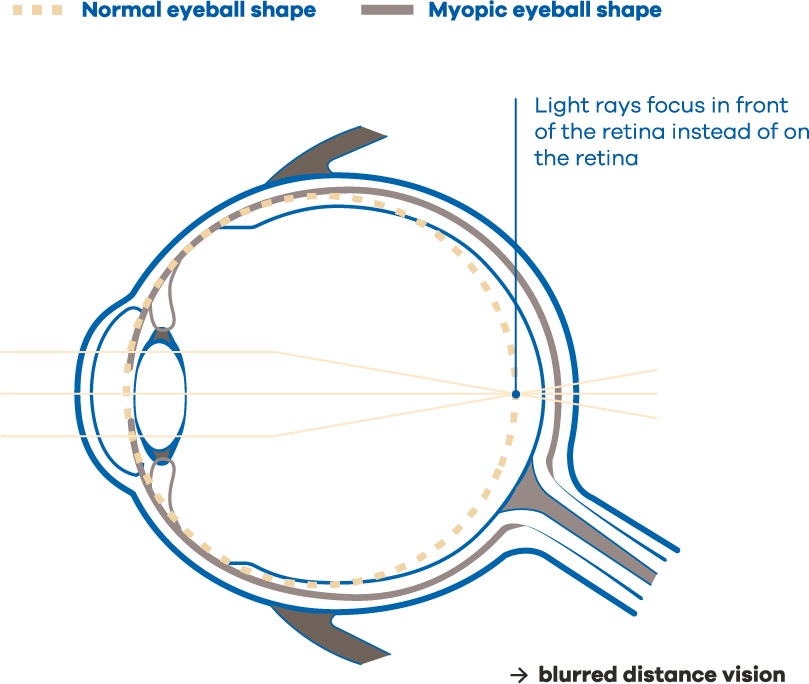
That word grown is the important one. Childhood myopia is tied to the growth of the eye, and children are still growing. This is why a child’s prescription tends to get stronger year on year rather than staying where it started, and why it usually settles somewhere in the late teens or early twenties.
It is also why eye care professionals now talk about slowing myopia down, not only about correcting the blur. An ordinary single vision lens makes the world sharp again, which matters enormously day to day — but it does nothing about the growth underneath.
The bigger picture
Why Myopia Is Increasing
Myopia has always existed. What has changed over the last few decades is how many children have it, and how young they are when it begins. Researchers point to a combination of factors rather than one single cause.
Less time outdoors
Daylight appears to play a protective role in how a young eye grows. Children today spend much more of the day indoors than children did a generation ago, and indoor lighting is a small fraction of the brightness available outside — even on an overcast afternoon.
More near work, starting younger
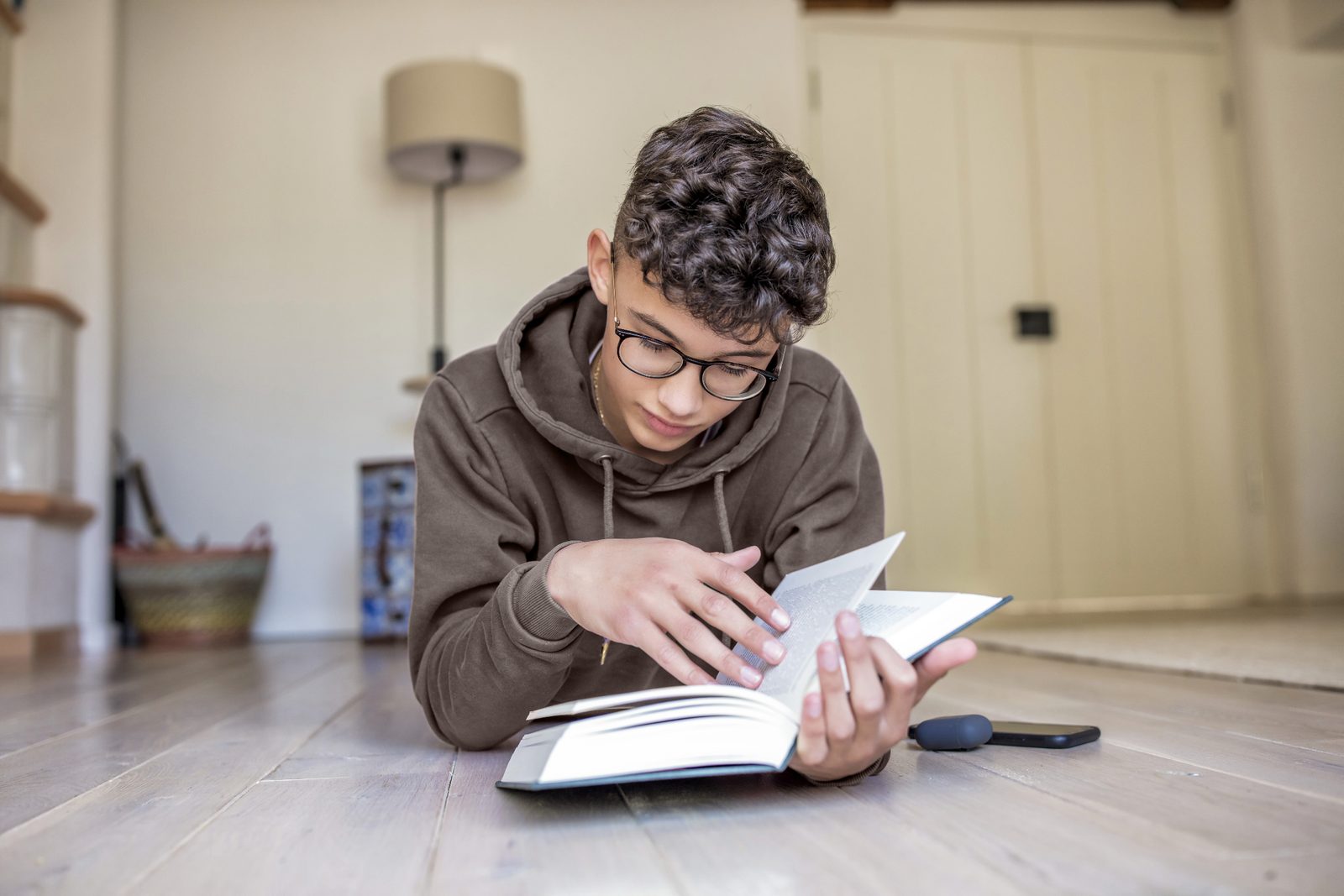
Reading, writing, homework and tuition all hold the eyes at a short, fixed distance for long stretches. Research shows that more time spent on near-work activities is associated with a greater likelihood of myopia.
Screens on top of school work
Screens are less a separate villain than more of the same near work, added to a day that was already full of it — often carried on into the evening, and usually held closer to the face than a book would be.
Family history
If one parent is short-sighted, a child is more likely to become short-sighted. If both parents are, more likely still. Genes do not decide the outcome on their own, but they set the starting point — and they are the reason two children with similar habits can end up in very different places.
And one factor that is really a consequence
Myopia is starting earlier than it used to, and early onset matters on its own. A child who becomes short-sighted at seven has many more growing years ahead of them than a child who becomes short-sighted at thirteen — and more growing years means more progression. Age at onset is one of the strongest indicators of how high a prescription is likely to climb by adulthood, which is why acting early is worth so much more than acting later.

Half the world by 2050
An estimated 5 billion people, or half of the global population, could be affected by short-sightedness by 2050.

Near work raises the risk
Research shows that more time spent on near-work activities is associated with a greater likelihood of myopia.
Why It Matters More Than a Stronger Prescription
Day to day, myopia gets in the way of ordinary things. A child who cannot read the board copies it down wrong, or stops trying. A child who cannot track a ball across a field stops choosing the games that need it. Tired eyes and end-of-day headaches are common. None of this announces itself as an eye problem — it usually looks like a child who has gone quiet, or whose marks have slipped for no obvious reason.
The longer view is the reason eye care professionals take childhood myopia seriously rather than treating it as an inconvenience. The higher a prescription climbs, the longer the eyeball has become, and a longer eye carries a higher lifetime risk of eye health problems in adulthood.
That is not a prediction about any individual child, and it is not a reason to be alarmed. It is simply the reason that slowing progression during the growing years is worth doing, instead of updating the lenses a little stronger each year and leaving it there.
The Signs Parents Notice First
Because children rarely report blurred vision, the first clues are almost always behavioural. These are the ones parents and teachers tend to spot:
- Squinting or screwing up their eyes to see something across the room.
- Sitting very close to the television, or holding a book or tablet close to their face.
- Moving to the front of the classroom, or asking their teacher to be moved forward.
- Rubbing their eyes often, or complaining of headaches and tired eyes after school.
- Losing their place while reading, or reading noticeably more slowly than they used to.
- Losing interest in sports and games that depend on seeing at a distance.
- School results slipping without any other obvious explanation.
One or two of these on their own do not mean very much. A pattern is worth an eye examination — and so, honestly, is the absence of a pattern, because children’s eyes are meant to be checked on a schedule rather than only when something already looks wrong.
What You Can Do
There is no cure for myopia, and nothing on this list will reverse a prescription your child already has. What these things can do is influence how fast it progresses from here, which is the part that is still open.
Start with the eye examination
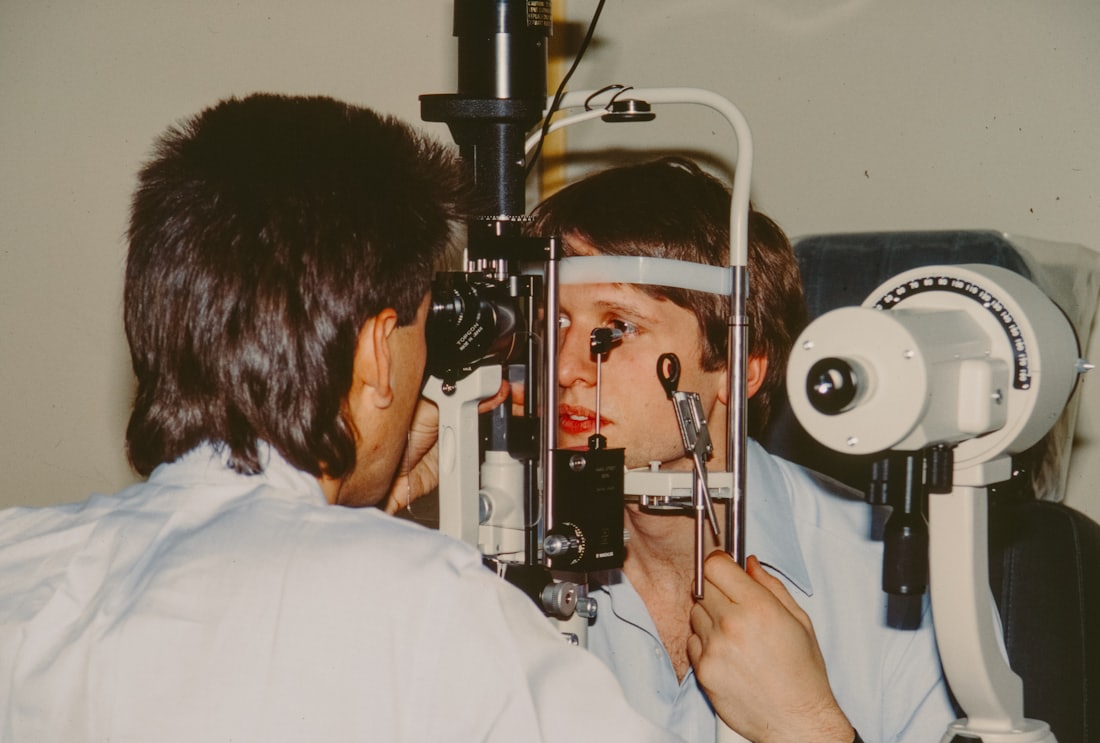
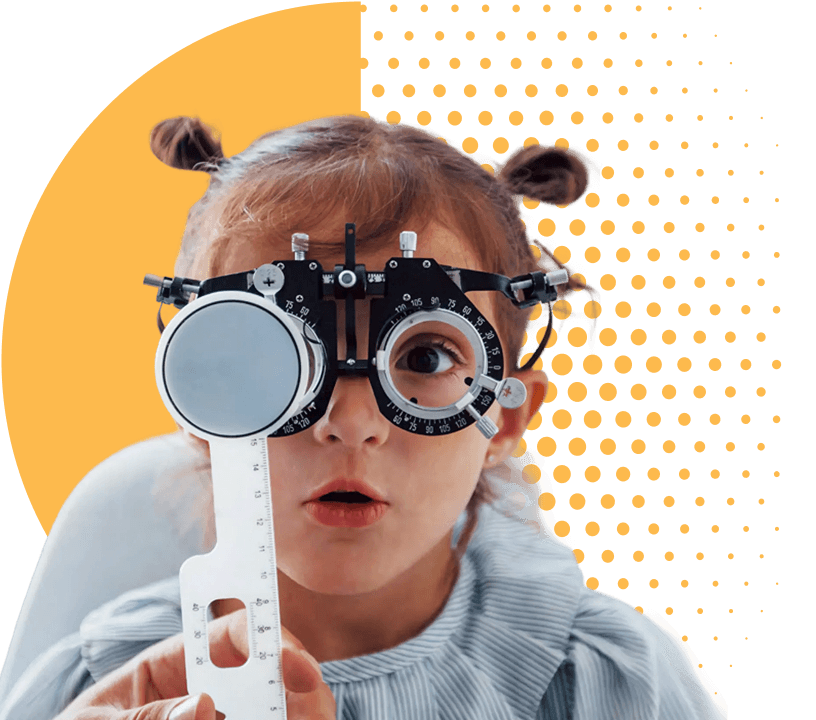
Everything else is easier to judge once someone has measured your child’s eyes. An eye care professional can tell you whether myopia is present, how quickly it has moved since the last visit, and which options are appropriate at your child’s age.
- Keep to the examination schedule. Eyes are checked from infancy onward at set stages, then at the start of each school year, so the prescription is measured rather than guessed at.
- Get them outside every day. Time outdoors is the habit most consistently associated with a lower risk of myopia developing. It does not have to be sport — daylight is the active ingredient.
- Break up long stretches of near work. Short, regular pauses to look at something far away cost almost nothing and are easy to build into homework and screen time.
- Watch the working distance and the light. Reading held very close to the face, or done in poor light, is the habit most likely to go unnoticed at home.
- Ask about myopia control, not just correction. Eye drops, spectacle lenses and contact lenses have all been shown to slow progression. Spectacle lenses are widely recommended because they are safe and easy for a child to wear.
Where MiYOSMART Fits
MiYOSMART is a spectacle lens built for this exact problem. A clear central zone corrects your child’s vision the way any lens would, and the treatment zones surrounding it work at the same time to slow the eye’s growth. That is D.I.M.S. Technology, and it is why one lens can do two jobs at once.
In a two-year randomised clinical trial, MiYOSMART slowed myopia progression by 59% and axial eye growth by 60% on average, compared with standard single vision lenses.
No lens can guarantee that myopia stops in every child, and MiYOSMART does not replace regular eye examinations. What it offers the growing years is a treatment alongside the correction, in a form a child will actually wear all day.